

If you’ve ever used henna for a wedding, a festival, or a professional beauty service, there’s a good chance the best experience you had come from a product that originated in one very specific part of India a small town in Rajasthan called Sojat.
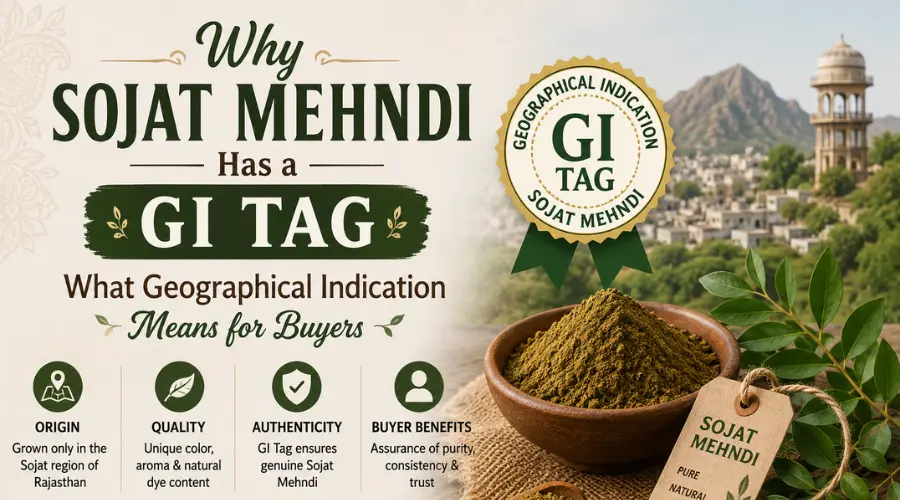
Sojat mehndi isn’t just popular because of tradition or good marketing. It’s recognized by the Government of India with a Geographical Indication (GI) tag a formal certification that places it in the same category as Darjeeling Tea, Basmati Rice, and Kanchipuram Silk. For buyers, that tag changes everything about how you should think about what you’re purchasing, and from whom.
This guide explains what a GI tag actually means, why Sojat earned it, and what it should mean for you every time you buy henna.
What Is a Geographical Indication Tag?
A Geographical Indication GI for short is a sign used on products that have a specific geographical origin and possess qualities or a reputation that are due to that origin. It’s a form of intellectual property protection, recognized under international trade law.
In practical terms, a GI tag tells you: this product is what it claims to be, it comes from where it says it comes from, and its quality is tied directly to that place of origin.
Think of French Champagne. Sparkling wine made outside the Champagne region of France cannot legally be called Champagne no matter how good it is. The name belongs to the place. GI protection works the same way for Sojat mehndi. The name carries the geography, and the geography carries the quality.
India has granted GI tags to hundreds of products across agriculture, handicrafts, food, and textiles. Sojat mehndi is one of them and earning that tag was not a formality. It required documentation, verification, and formal recognition of the product’s unique origins and qualities.
Why Sojat? The Story Behind the Tag
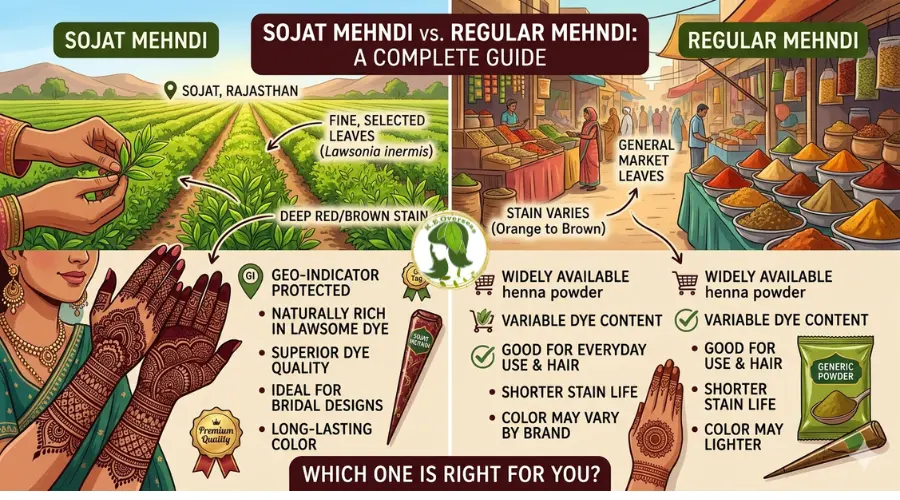
Sojat is a town in the Pali district of Rajasthan. For generations, the region has cultivated henna the plant known botanically as Lawsonia inermis on a scale that few other places in the world can match. Rajasthan accounts for the majority of India’s henna production, and Sojat sits at the very center of that industry.
The soil and climate of this region create conditions that are uniquely suited to henna cultivation. The sandy, well-drained soil of the area, combined with the dry heat and specific rainfall patterns of this part of Rajasthan, produces henna leaves with an exceptionally high lawsone content. Lawsone is the natural dye compound in henna responsible for the dark, rich color it imparts on skin and hair. More lawsone means darker stain, faster color development, and longer-lasting results.
This isn’t something that can be replicated by growing the same plant somewhere else. The local environment what the French call “terroir” when talking about wine shapes the chemistry of the plant itself. Sojat henna powder made from these leaves stains darker and more reliably than henna grown in other regions, and that difference is measurable and consistent.
The GI tag formally acknowledges this. It recognizes that Sojat mehndi’s quality is inseparable from its origin and protects that quality from being diluted by imitations using the Sojat name without the substance behind it.
What the GI Tag Means for Buyers
Understanding the GI tag in theory is one thing. Knowing what it means for your actual purchase decisions is another.
You Know You’re Getting the Real Thing
The henna market globally has a problem with adulteration and mislabeling. Products labeled as “natural henna” or “pure mehndi” frequently contain synthetic dyes, chemical additives, or lower-quality henna from other regions blended in to stretch volume. Some so-called henna products contain paraphenylenediamine (PPD), a chemical dye that can cause serious skin reactions.
When you buy authentic Sojat henna powder from a verified source, you’re buying a product tied to a GI-protected origin. That protection creates accountability in the supply chain. A genuine henna supplier who sources from Sojat and markets their product accordingly has something to lose if the product doesn’t match its claimed origin.
Color and Stain Quality Are More Predictable
Professional henna artists know the frustration of inconsistent products. One batch stains deep burgundy; another from a different brand barely leaves a mark. With authentic Rajasthani mehndi from the Sojat region, consistency improves. The high lawsone content means you can trust the product to perform reliably which matters enormously when you’re working on a bridal design or a paying client.
You’re Supporting an Entire Regional Economy
Sojat’s henna industry supports thousands of farmers, processors, and traders. When buyers specifically seek out genuine Sojat henna powder and purchase from a trustworthy henna supplier with transparent sourcing, they’re directing money toward the people and place that actually produce the quality they’re paying for. GI tags exist partly for this reason to ensure economic value flows back to the communities that created and sustained the product’s reputation.
It Sets a Standard for What to Demand from Suppliers
For retailers, salon owners, henna professionals, and wholesalers, the GI tag creates a useful benchmark. It gives you language and legitimacy when specifying what you want. Asking your supplier for GI-tagged Sojat mehndi is not just a preference it’s a verifiable quality standard.
Rajasthani Henna in the Global Market
Rajasthani henna has long been exported across the Middle East, Africa, Europe, the United States, and Southeast Asia. In many of these markets, henna is deeply embedded in cultural and beauty practices used in weddings, festivals, hair care, and everyday beauty routines.
The global demand for natural, chemical-free beauty products has significantly increased interest in authentic Rajasthani mehndi over the past decade. Consumers in export markets are increasingly aware of ingredient quality and origin traceability. The GI tag makes Sojat mehndi more competitive in these markets it provides third-party recognition of quality that goes beyond a manufacturer’s self-promotion.
For export-focused businesses in India, working with a reliable henna supplier who sources directly from Sojat and can provide the right documentation is becoming more important as international buyers apply higher scrutiny to their supply chains.
How to Identify Genuine Sojat Mehndi
Not everything sold under the Sojat name is the real product. Here’s how to improve your chances of buying genuine Sojat henna powder:
Source from reputable suppliers: Work with a henna supplier who is transparent about their sourcing. Genuine suppliers can tell you where their henna comes from, who grows it, and how it’s processed.
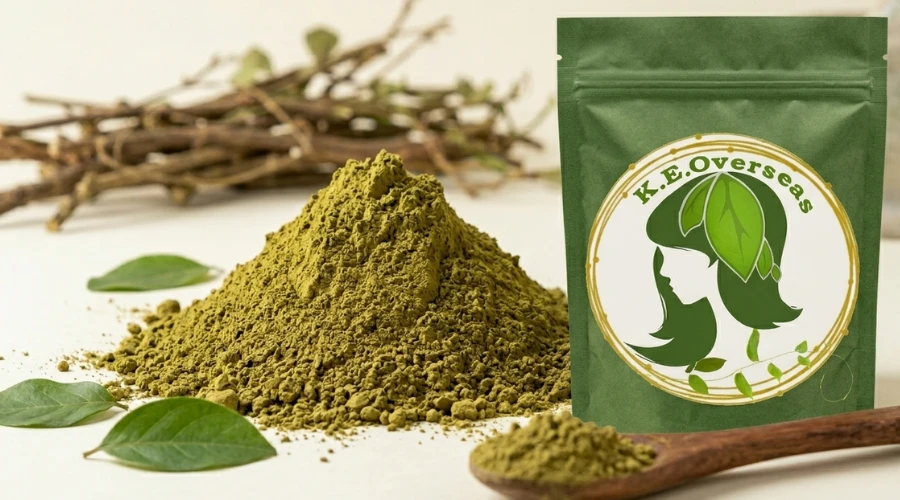
Check the color of the powder: Authentic Sojat henna powder has a natural green color not brown, not yellowish-grey. The processing method preserves the chlorophyll in the leaves, which gives the powder its characteristic hue. If the powder looks brown or dull, it may have been over-processed or adulterated.
Test before committing to bulk orders: Request a sample before placing a large order. Conduct a simple patch test on skin and check the stain color after 24 to 48 hours. Quality henna should leave a deep orange-to-red stain that darkens to burgundy or brown over the following day.
Ask for documentation: For commercial or export buyers, ask your supplier for proof of origin and batch quality. Established suppliers with genuine product should have no difficulty providing this.
Avoid suspiciously low prices: Quality henna from Sojat has a cost of production. If a price seems too good to be true for a product claiming to be pure, high-grade Sojat mehndi, it almost certainly is.
The GI tag on Sojat mehndi is more than a government certificate on a package. It represents centuries of agricultural knowledge, a unique natural environment, and an entire community whose livelihood depends on the plant they’ve cultivated for generations.
For buyers whether you’re an individual consumer, a salon professional, a retailer, or an international importer it’s a signal worth paying attention to. It tells you that what you’re buying has a real story, real origins, and real quality that can be traced, tested, and trusted.
In a market where imitation is common and labels are easy to print, Rajasthani henna with genuine Sojat origins stands apart. Choose your henna supplier wisely, ask the right questions, and let the GI tag guide you toward a product that delivers everything it promises.