

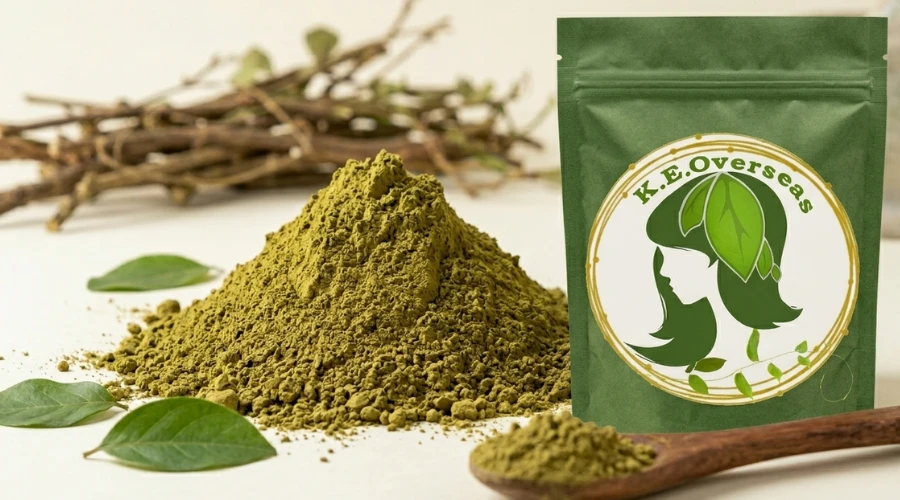
India supplies more henna to the global market than any other country on earth. Rajasthan alone particularly the town of Sojat in the Pali district produces the bulk of the world’s commercially traded henna powder, and the supply chain stretching from those fields to buyers in the Middle East, Europe, North America, and Southeast Asia is well-established, competitive, and occasionally inconsistent.
That inconsistency is the real challenge for international buyers. The volume is there. The variety is there. But henna powder suppliers in India range from highly professional export-oriented manufacturers with documented quality systems to informal traders who buy on the spot market, blend indiscriminately, and sell under whatever specification the buyer asked for without the verification to back it up.
This guide is a practical B2B checklist for any international buyer who is sourcing henna powder from India for the first time or wants to apply more rigour to an existing supplier relationship. It covers every checkpoint that matters from lawsone content verification to export documentation and explains why each one is worth the time it takes to complete.
Start With the Product Specification Before You Start Talking to Suppliers
The single most common sourcing mistake made by first-time henna buyers is starting the supplier search before establishing a clear product specification. Contacting ten suppliers without a defined specification produces ten quotations that cannot be meaningfully compared because they are all offering slightly different things.
Before reaching out to any henna powder manufacturers, define in writing what you actually need. The specification should cover lawsone content the natural dye compound in henna responsible for the colour it produces on skin and hair expressed as a minimum percentage. Standard commercial henna powder typically runs between 1.5% and 2.5% lawsone. Premium body art grade henna for professional use starts at 2.5% and can reach 3.5% or higher in the best Sojat-sourced material.
The specification should also cover moisture content typically 8% to 10% maximum for shelf-stable product particle size or mesh fineness, microbial limits if the product will be used in cosmetic or skin contact applications, and the absence of adulterants. Once these parameters are written down, every supplier you contact is being evaluated against the same standard, and comparisons become meaningful.
Evaluating Henna Powder Suppliers: The Core Checklist
Verify the Supplier’s Actual Manufacturing Capability
The henna supply chain in India has multiple layers farmers, processors, traders, and exporters and not everyone who presents as a manufacturer actually processes henna in-house. A trader buying powder from a mill and reselling it is not a manufacturer, even if they present themselves as one. The distinction matters because a genuine manufacturer controls the raw material quality, the processing parameters, and the consistency of their output in a way that a trader cannot.
Ask specifically about the processing facility. Where is it located? Does it own the facility or operate from a leased unit? What equipment is used for grinding and sifting? A genuine henna powder manufacturer will answer these questions in detail and will welcome a facility visit or a third-party audit. Evasive answers to direct questions about production capability are a clear signal.
Check APEDA Registration and Export Credentials
Any legitimate henna exporter from India must be registered with APEDA the Agricultural and Processed Food Products Export Development Authority. APEDA registration confirms that the supplier is authorised to export agricultural commodities from India and has met the baseline administrative requirements for export operations. Verify the registration number directly through APEDA’s online portal rather than accepting a copy of the certificate at face value.
Beyond APEDA, check for relevant food safety certifications. ISO 22000 or FSSC 22000 certification indicates that the manufacturer has a documented food safety management system. For buyers supplying the EU, US, or GCC markets, HACCP implementation is increasingly a baseline requirement. Some buyers in the organic and natural cosmetics space additionally require COSMOS or NATRUE certification, which are specific to cosmetic ingredient supply chains.
Request and Independently Verify Laboratory Test Reports
Every credible henna powder supplier should provide a Certificate of Analysis (CoA) for each batch, showing lawsone content, moisture, microbial counts, heavy metals, and pesticide residue results. The key word here is independently verify. Supplier-provided test reports from in-house or affiliated laboratories tell you what the supplier wants you to know. An independent test from an accredited third-party laboratory tells you what the product actually contains.
For buyers supplying European markets, pesticide residue testing is particularly critical. The EU’s maximum residue limits (MRLs) for cosmetic and food-grade plant materials are strictly enforced, and Indian agricultural commodities including henna have appeared in EU RASFF (Rapid Alert System for Food and Feed) notifications for pesticide exceedances. Requiring pre-shipment pesticide residue testing from an accredited laboratory is not excessive caution; it is standard practice for serious buyers supplying regulated markets.
Assessing Quality beyond the Laboratory Report
Laboratory results confirm that a product meets its specification at the time of testing. They do not tell you how the product was grown, harvested, processed, or stored factors that affect performance characteristics that tests do not always capture.
Lawsone Content and Dye Release Performance
Lawsone content measured in a laboratory and dye release performance in actual use are related but not identical. The dye release depends on the particle fineness of the powder, the freshness of the material, and whether the aromatic terpene compounds responsible for the characteristic henna fragrance have been preserved through proper storage and processing.
Fresh, properly processed henna powder from a current crop will outperform older powder with a similar lawsone content on paper. Ask henna powder suppliers about the crop year of the material they are quoting from, how it has been stored, and whether a freshness or aromatic assessment is available alongside the standard analytical tests. A supplier who understands henna performance will engage with this conversation meaningfully. One who only talks about price will not.
Physical Assessment of Samples
Before committing to any volume order, request genuine production samples not specially selected material prepared for quotation purposes. The sample should be a representative draw from current inventory or a current production batch. Assess the colour of the powder visually: quality Sojat henna powder is a vivid, uniform green. Brownish, khaki, or uneven coloration suggests over-processing, age, or adulteration.
The fragrance should be characteristic earthy, slightly floral, distinctively herbal. Powder that smells flat or chemical has either been stored poorly or contains adulterants. Conduct a basic paste test on skin: mix a small quantity with lemon juice and sugar, apply to the inner wrist, and allow to develop for at least eight hours. A good quality batch will produce a deep orange-to-burgundy stain. Weak, patchy, or orange-only results indicate low lawsone content or material that has degraded.
Packaging, Labelling and Export Documentation
Packaging Specification for Different Markets
The packaging format for exported henna powder varies significantly by market. Bulk buyers in the manufacturing and processing sector typically source in 25kg or 50kg kraft paper or multi-wall bags. Retail-format buyers for branded consumer products may source in smaller packs from 100g upward, with custom label printing requirements. Professional body art suppliers often want 100g or 500g resealable packs with specific tamper-evident features.
Clarify with prospective henna powder manufacturers whether they handle packaging customisation in-house or outsource it. In-house packaging capability generally means faster turnaround, better quality control over the finished pack, and more flexibility on pack sizes and label specifications. Outsourced packaging adds a step where quality issues can enter the chain.
Export Documentation for Global Markets
A standard henna powder export shipment from India to international markets requires a commercial invoice, packing list, certificate of origin from the relevant Indian chamber of commerce, a phytosanitary certificate from India’s National Plant Protection Organisation, and a fumigation certificate confirming the cargo has been treated against storage pests. For GCC markets, a Certificate of Analysis authenticated by the chamber of commerce is typically also required.
Buyers supplying regulated markets should additionally require the supplier to provide a Declaration of Conformity confirming the product meets the relevant cosmetic or food safety regulations of the destination market. This is a supplier commitment document rather than a certification, but it establishes accountability and is increasingly expected by importers in Europe and North America.
Building a Long-Term Supplier Relationship That Works
A single successful shipment from a henna supplier does not establish reliability. Consistency across multiple shipments, across different crop seasons, and across changing supply conditions is what reliability actually means in agricultural commodity procurement.
The buyers who report the most stable henna supply relationships are those who invest in those relationships actively visiting the facility at least once per year, communicating clearly about future volume requirements so the supplier can plan procurement, providing timely feedback when product performance varies, and maintaining payment terms that make the relationship commercially worthwhile for the supplier.
Henna powder manufacturers with strong export track records have choices about which buyers they prioritise. A buyer who pays on time, communicates professionally, provides advance notice of volume requirements, and treats the supplier as a partner rather than a commodity vendor will consistently receive better service, better pricing, and better access to premium material during seasons when supply is tight.
Choosing henna powder suppliers from India for global markets is not a one-time transaction it is a supply chain decision with consequences that play out across multiple seasons and shipments. The suppliers who perform consistently are those who are transparent about their production capability, back their quality claims with verifiable documentation, and understand the regulatory requirements of the markets their buyers serve.
The checklist in this guide specification before search, manufacturing verification, APEDA and certification checks, independent laboratory testing, physical sample assessment, packaging and documentation review, and relationship investment is not an exhaustive compliance exercise. It is a practical framework that experienced commodity buyers use to separate suppliers worth building relationships with from those whose promises exceed their capability.
Apply it systematically. The time spent upfront is a fraction of the time lost managing problems that a thorough evaluation process would have prevented.