

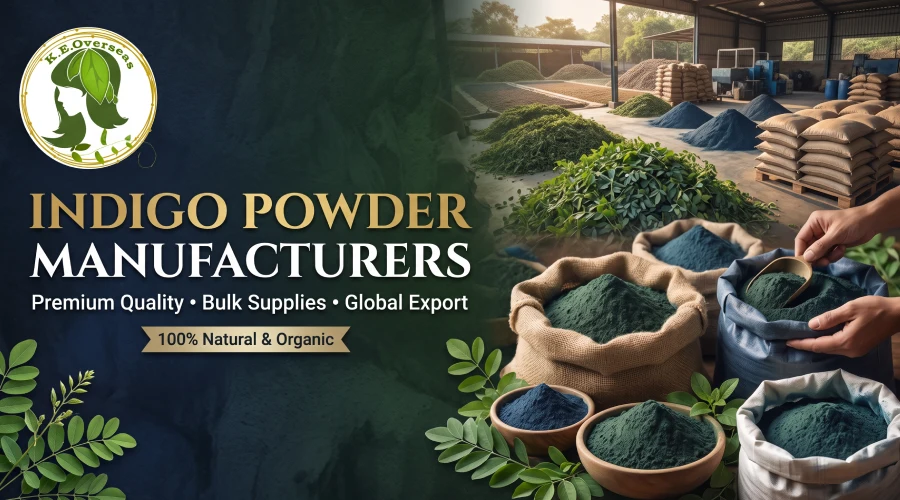
The market demand for beauty products from plants keeps rising as consumers seek substitutes for common hair coloring products. Many natural hair care companies have become increasingly interested in using botanical ingredients that not only enhance traditional beauty practices but also meet the demands of consistency and safety. One such ingredient is indigo powder, whose importance in the formulation of natural hair colors cannot be underestimated. Selecting the best indigo powder suppliers, therefore, remains a significant task for any business interested in developing natural hair dyes, herbal hair care products, and even private-label beauty products.
Quality indigo powder manufacturers how the ingredients are sourced, processed, tested, packed, and stored. The differences in raw materials and manufacturing processes can affect the quality of the final product, which makes it extremely necessary to select the right suppliers for your business needs as a wholesaler, distributor, or cosmetics company.
Henna Manufacturer could be a good name worth considering during research on natural hair colors and other sources of botanical ingredients.
How to Use Indigo Powder for Hair Naturally
Indigo powder is normally made from the leaves of the indigo plant, which is usually referred to as Indigofera tinctoria. These leaves undergo processing to become dry, after which they are grounded to create a powder. In natural hair care, indigo powder is used as an additive ingredient, specifically for dyeing or coloring hair, and it is often combined with henna during the coloring process.
The outcome of the color depends on different variables, such as the formula, application method, initial color of the hair and the state of the hair. One cannot expect indigo powder to yield the same results in all applications and for all users.
Manufacturers of natural hair care products should take into account the nature of the ingredient, how well it is processed, its consistency and how it will be used by the consumer. A reliable manufacturer should give all the necessary information about the product.
Use of Indigo Powder in Hair Dyeing Naturally
Indigo powder is always derived from the leaves of indigo plants, which are always called Indigofera tinctoria. The leaves are always processed until they become dry and then they are ground to form a powder. Indigo powder in natural hair care is used as an additional ingredient in hair coloring. It is always added together with henna when coloring the hair.
Different factors can determine the outcome of the color like the formula used, the application process, the initial color of the hair and the current state of the hair. One cannot hope to get similar results when using the indigo powder in all processes and on all consumers.
A manufacturer of natural hair care products must consider all these factors regarding the product used, the processing process and its consistency and how the consumer uses the product. A good manufacturer must provide all the relevant information regarding the product.
Responsible Sourcing of Indigo Leaves
The starting point is the raw botanical ingredient. Conditions of growth, harvesting, storage, and transport all might affect the state of the indigo leaves before arriving at the processing plant.
Producers and wholesalers might collaborate with farmers or raw-materials traders to get appropriate leaves. The responsible sourcing of the botanical ingredient must include botanical identification, material condition, supplier reliability, and possibility of contamination from harvesting and transport.
In the case of wholesalers, knowledge of the sourcing process is necessary to gain trust in the ingredient. Brands might check whether the wholesaler keeps records of material received, checks the raw-material quality, and has procedures to address inconsistent or inappropriate batches.
Moreover, responsible sourcing will help plan production more effectively. Manufacturers will know about their raw materials, and thus, will have control over the process of processing and the quality of every batch.
Process Methods and Indigo Powder Consistency
After collecting proper leaves, they need to be processed for use as per the purpose. This is done by drying since excess moisture may lead to poor storage qualities of the product and increased risks of spoilage. It is important that the process of drying is appropriate and well-managed.
After drying, the leaves are milled and processed so as to obtain a powder with required qualities. Particle size is known to influence mixing of the powder with water and incorporation into any formulation. Smaller particle size does not guarantee that the powder will be of high quality since other factors are also important.
It is important to have control measures that help to minimize contamination and consistency throughout the manufacturing process. Proper processing methods, cleaning of equipment and handling measures may minimize the variation as much as possible.
When looking for indigo powder suppliers, it is important that beauty companies ask the suppliers about specifications of the powders, batch-to-batch consistency and documentation of the processes involved.
Testing and Product Documentation
Testing is part and parcel of proper botanical ingredients supply. The type of testing and inspection that can be undertaken to establish various qualities will depend on the targeted market and product specifications.
There is no universal set of tests that need to be done. The specific testing depends on the nature of the ingredient, its intended use, relevant regulations, and what is being claimed about the ingredient.
Buyers should request documents that would be pertinent to the product being acquired, instead of just accepting that all suppliers have the same testing program.
Traceability of the batch numbers and records is also beneficial because it helps businesses tie their ingredient supply to its processing or manufacturing background.
Hair care brands utilizing natural ingredients should store supplier documentation, purchasing information, product specifications, and test reports where applicable.
Indigo Powder Packaging and Indigo Powder Storage for Wholesale Purchases
Even after good processing of indigo powder, its poor packaging or storage might result in damage of this product. Moisture, inappropriate temperatures, air, and other factors might cause deterioration of the indigo powder quality when being transported and stored.
The packaging should be adequate for powder’s properties and intended distribution channel. The wholesalers should pay attention to the packaging size, sealability, appropriateness of materials, labeling, and protection during transportation. The labeling might be used in order to indicate product’s name, batch number, net quantity, and storage conditions.
The storage conditions should correspond to the recommendations provided by the supplier. One should store goods in clean and dry places and manage the stock taking into account shelf life information. The first-expiry-first-out system of stock management might decrease the probability of exceeding the shelf life period.
The international buyers should also pay attention to the shipping time, import regulations, and other factors.
Selecting a Suitable Wholesale Supplier for Your Brand
A good supplier will depend on several elements such as the size of the business, its target market, specific product requirements, and the needs of the buyer.
When comparing suppliers of indigo powder, consider the following criteria:
- Specifications of the product and botanical origin.
- Methods used for quality control and corresponding documentation.
- Minimum order sizes and the prices for wholesale.
- Packaging options, storage recommendations, and shelf life of the powder.
- Traceability of batches and consistency between repeated orders.
- Process of communication and handling problems with the quality of the product.
The cost of the product must be considered along with other aspects like the specifications of the product and cost of delivery. Even a product that is offered at low prices may not be an economic choice when it comes to documentation or delivery.
Before making a big purchase, consider asking for a sample or smaller trial order, if it is possible.
Position of Henna Manufacturer within Natural Hair Color Sourcing
Firms looking into the production of hair colors made from botanicals might want to look into Henna Manufacturer when researching the possibilities for their hair color products with henna and other natural ingredients.
Yet, buyers will want to check whether Henna Manufacturer actually offers both henna products and indigo powder as these ingredients are commonly used in tandem within plant-based hair coloration procedures.
In any case, Henna Manufacturer should be contacted to learn about their available products, prices, product information and whether they would suit the needs of the prospective client’s business.
In order for a good relationship with the supplier to be built, there must be clarity in specifications, communication, documentation and delivery of orders.
Reliable manufacturers of indigo powder have an important part to play in enabling natural hair care brands to procure botanical ingredients with greater assurance. Raw material selection, processing, quality testing, packaging and documentation all play their part in ensuring a more reliable supply chain.
When it comes to assessing suppliers in the case of new entrants into the plant-based hair color market, one should look at quality and reliability, and not only price. Checking out suppliers like Henna Manufacturer, verifying their current products and product documentation can be helpful in this endeavor.